Best Practices for Peptide Storage: A Complete Guide for Research Laboratories
Peptide integrity is essential for producing reliable and reproducible research results. Whether you're working with custom synthesized peptides or commercially available research peptides, proper storage can significantly reduce degradation, preserve purity, and maintain experimental consistency.
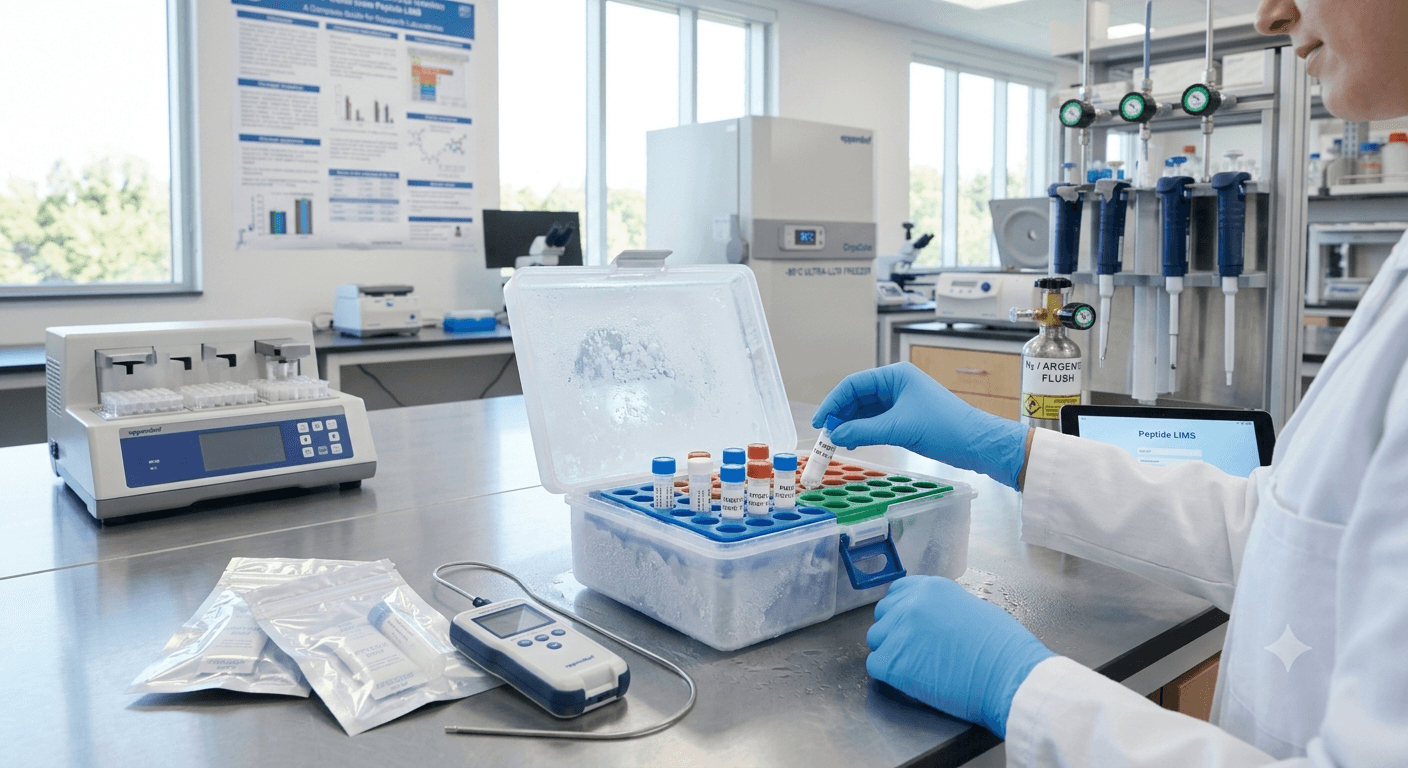
Whether you're working with custom peptides or catalog products, proper storage is one of the simplest ways to protect sample quality and improve experimental reproducibility. While peptide synthesis and analytical characterization receive a great deal of attention, storage conditions are sometimes treated as an afterthought. In reality, even a well-characterized peptide can lose integrity if it's handled or stored improperly.
There is no single storage protocol that works for every peptide. Stability depends on factors such as amino acid composition, sequence length, chemical modifications, formulation, and intended application. That said, a few general principles can help minimize degradation and maintain sample integrity throughout its lifetime in the laboratory.
Keep Peptides Lyophilized Until They're Needed
Whenever possible, peptides are best stored in their lyophilized form. Removing water significantly slows many degradation processes and generally improves long-term stability compared to storing peptides in solution.
Lyophilized peptides should be kept in tightly sealed containers and protected from humidity. It's also good practice to avoid repeatedly removing vials from cold storage, as temperature changes can lead to condensation inside the container if handled incorrectly.
For researchers planning experiments weeks or months in advance, keeping peptides lyophilized until immediately before use is often the most practical approach.
Choose Storage Temperatures Carefully
The appropriate storage temperature depends on both the peptide and how long it will be stored.
For samples that will be used in the near future, refrigerated storage may be sufficient if recommended by the supplier. For longer-term storage, freezing is commonly used to help preserve peptide stability.
Rather than applying the same conditions to every sample, it's worth checking the product documentation. Peptides containing oxidation-sensitive residues or specialized modifications may require additional handling considerations.
Moisture Is One of the Biggest Enemies
Moisture exposure is a common cause of reduced peptide stability.
A small amount of condensation can introduce water into a vial, particularly if a frozen sample is opened immediately after being removed from the freezer. A better approach is to allow the unopened vial to reach room temperature before opening it. This simple step helps prevent moisture from condensing directly onto the peptide.
Keeping containers tightly sealed and limiting unnecessary exposure to ambient air also reduces the chance of water entering the sample.
Avoid Repeated Freeze-Thaw Cycles
Once a peptide has been reconstituted, repeated freezing and thawing can gradually affect its stability. Although the extent of this depends on the peptide itself, minimizing freeze-thaw cycles is generally considered good laboratory practice.
Aliquoting freshly prepared peptide solutions into smaller volumes is an easy way to avoid repeatedly thawing the same stock solution. Each aliquot can then be thawed only once as needed for an experiment.
Besides improving sample stability, aliquoting often makes day-to-day laboratory work more convenient and reduces the risk of accidental contamination.
Reconstitute with Your Experimental Application in Mind
There isn't a universal solvent that's suitable for every peptide. Solubility depends largely on amino acid composition and overall peptide chemistry.
Before preparing a solution, it's worth reviewing the manufacturer's recommendations and considering the downstream application. Some peptides dissolve readily in water or aqueous buffers, while others may require alternative solvents before dilution into the final working solution.
Whatever solvent is chosen, using high-quality laboratory reagents and preparing only the quantity needed for upcoming experiments helps reduce unnecessary waste.
Protect Sensitive Peptides from Light and Oxidation
Not every peptide is particularly sensitive to light, but fluorescently labeled peptides and sequences containing certain amino acid residues may require additional protection.
Using amber tubes, wrapping vials in foil, or simply minimizing unnecessary light exposure can help preserve these materials. Likewise, limiting prolonged exposure to air may reduce oxidation for susceptible sequences.
These precautions take very little extra effort and can be worthwhile for valuable or difficult-to-synthesize peptides.
Good Record Keeping Makes a Difference
Proper labeling is often overlooked until someone has to identify a vial months later.
Each sample should ideally include information such as:
- Peptide name or identifier
- Batch or lot number
- Concentration (if reconstituted)
- Solvent used
- Date of preparation
- Storage location
Maintaining accurate records improves traceability and makes it easier to interpret experimental results if questions arise later.
Common Storage Mistakes
Several issues appear repeatedly in research laboratories:
- Opening frozen vials before they have warmed to room temperature
- Leaving peptide solutions at room temperature longer than necessary
- Repeatedly thawing the same stock solution
- Assuming every peptide has identical storage requirements
- Poor sample labeling or incomplete documentation
Fortunately, these are all relatively easy to avoid with a consistent laboratory workflow.
Final Thoughts
Good peptide storage isn't complicated, but it does require consistency. Keeping peptides dry until they're needed, minimizing freeze-thaw cycles, using appropriate storage temperatures, and maintaining clear records all contribute to preserving sample integrity.
Perhaps the most important point is that peptides are not all the same. Two sequences with similar lengths can behave very differently depending on their amino acid composition or chemical modifications. For that reason, storage recommendations should always be considered alongside the supplier's documentation and the specific requirements of the experimental application.
Taking a little extra care during storage and handling can help ensure that the peptide you're working with today performs just as reliably in future experiments.
For laboratory and research use only. Not for human or veterinary use.